
The Cost of Automatic Solutions
The Cost of Automatic Solutions
Using an automated tool to fix a bug or write a function saves time today, but it can make you unable to fix that same problem three months from now.
This article explores the tension between efficiency and comprehension. While automation is often framed purely as a benefit for speed, recent research highlights a critical trade-off: when cognitive effort is offloaded without follow-up inquiry, long-term skill retention suffers. Understanding this dynamic allows engineers to build tools that accelerate work rather than replacing their own growing capabilities.
The Learning Cost of Offloading Debugging
A randomized controlled trial provides empirical evidence that using AI assistance during the acquisition of new concepts can significantly reduce mastery of those concepts. Specifically, this impact affects debugging ability and conceptual understanding. In a study group where participants used AI to debug but relied on the assistant to solve problems rather than asking clarification questions, they scored poorly on subsequent conceptual quizzes.
This suggests that skipping the moments where understanding truly develops leads to skill atrophy later. While observational data indicates AI can accelerate tasks by roughly 80% in certain contexts, this speedup comes with trade-offs in long-term skill retention if cognitive effort is offloaded without follow-up questions. The magnitude of skill erosion varies by task type, and results from studies consisting mostly of junior engineers may not fully represent senior developer contexts. However, the core mechanism of passive learning versus active inquiry remains a critical distinction for growth.
Interaction Patterns Determine Outcomes
The impact of automation depends heavily on how you interact with the tool. Passive delegation leads to lower quiz scores compared to active conceptual inquiry that maintains higher mastery. This distinction is between two modes of usage:
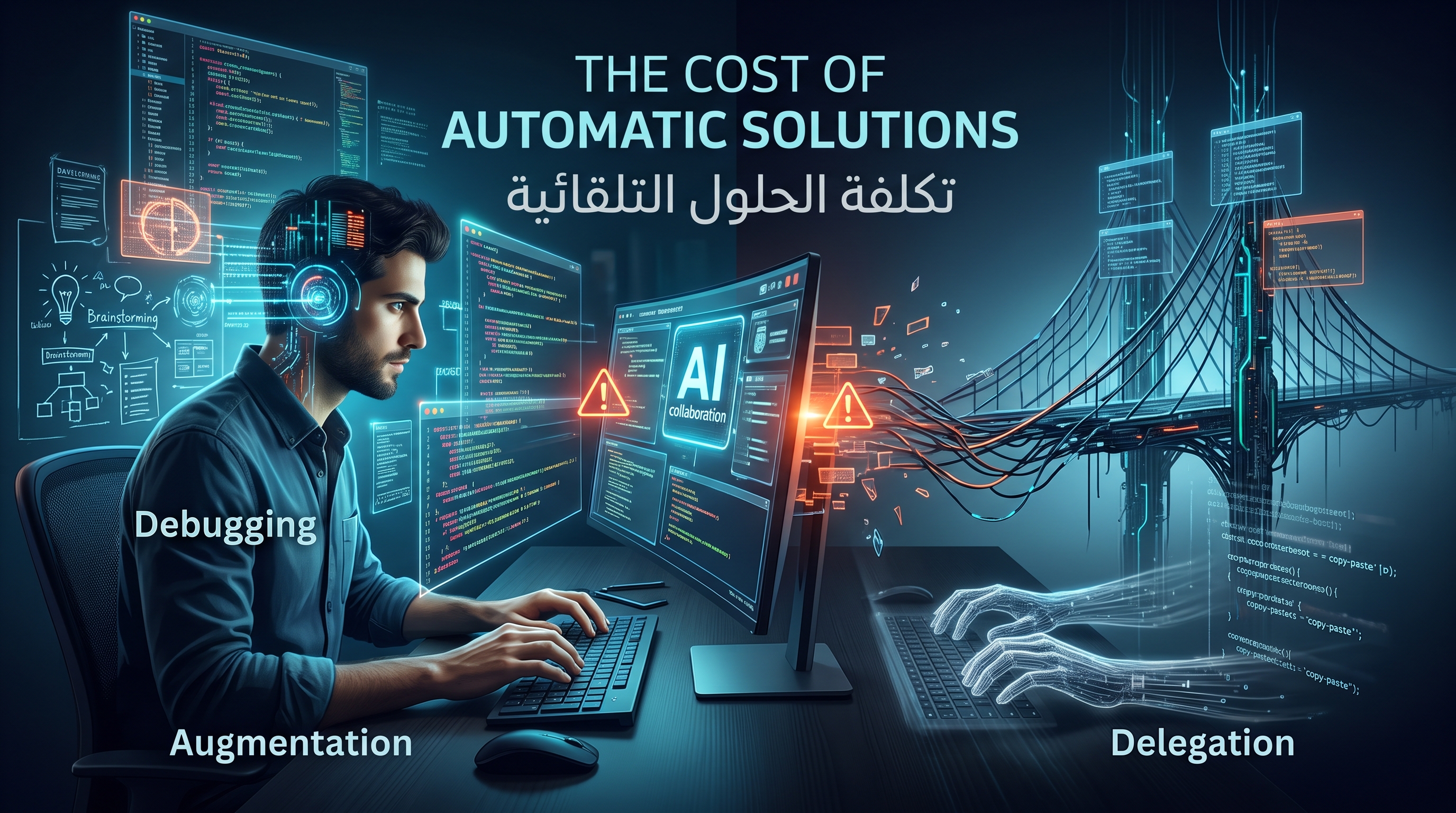
- Delegation: Copy-pasting output without reviewing or asking why. This erodes skills by replacing the struggle of debugging with instant resolution.
- Augmentation: Asking for explanations, verifying logic, and writing tests first before accepting a solution. This preserves understanding even when using external assistance.
When AI is used merely to produce code without conceptual inquiry, learning outcomes remain lower than manual work. Conversely, using the tool to explain generated code or answer specific questions about intent keeps engagement high. The difference lies in whether the engineer treats the tool as a crutch or a collaborator for exploration. Interaction patterns with AI tools correlate with learning outcomes; passive delegation leads to lower quiz scores while active conceptual inquiry maintains higher mastery.
Hidden Debt in Legacy Codebases
This reliance on implicit knowledge becomes most dangerous when working with existing systems. Practical experience from legacy code modernization suggests teams rely on implicit knowledge that AI agents lack, leading to subtle production failures when automation modifies undocumented logic.
Consider a team refactoring a monolithic legacy system where agents produced syntactically valid changes that broke production behavior because they violated undocumented business assumptions known only to the original authors. This highlights a specific failure mode: automated tools do not know tribal knowledge unless it is explicitly documented and ingested.
To mitigate this risk, incremental modernization strategies combined with characterization tests first can prevent reliance on incomplete knowledge during refactoring. Using AI to generate characterization tests for an existing module before any agent-assisted refactoring provides a safety net that preserves external behavior even when internal logic is unknown. This establishes boundaries before automation operates within those known limits.
Where Automation Remains Safe
It remains unclear whether the negative learning effects persist for senior engineers who have more stable mental models compared to junior developers, but certain tasks remain safe regardless of context. For high-confidence, bounded tasks like writing unit tests for isolated modules or generating documentation from existing code, automation does not significantly erode understanding.
Routine technical decisions that are truly mechanical rather than complex logic generation fall into a safer category for automation. When AI is used for conceptual inquiry to explain generated code rather than just produce it, learning outcomes remain comparable to manual work. Teams should distinguish between mechanical tasks and complex logic generation to apply the appropriate level of human oversight.
Balancing Speed with Understanding
The goal of using these tools should not just be speed, but ensuring your own understanding grows alongside the work you produce. Incremental modernization strategies combined with characterization tests first can mitigate the risk of relying on incomplete knowledge during refactoring.
In contexts where tribal knowledge has been explicitly documented and ingested into retrieval-augmented systems, agents can safely operate within known boundaries without breaking implicit contracts. However, without these explicit constraints, automation risks becoming a tool for skill erosion rather than acceleration.
Ultimately, the decision to automate should not rely on generic cost-benefit calculations but on specific questions about what you are trying to learn or understand. By asking clarification questions and verifying generated code, engineers can harness the speed benefits while preserving the critical cognitive engagement required for long-term professional growth.